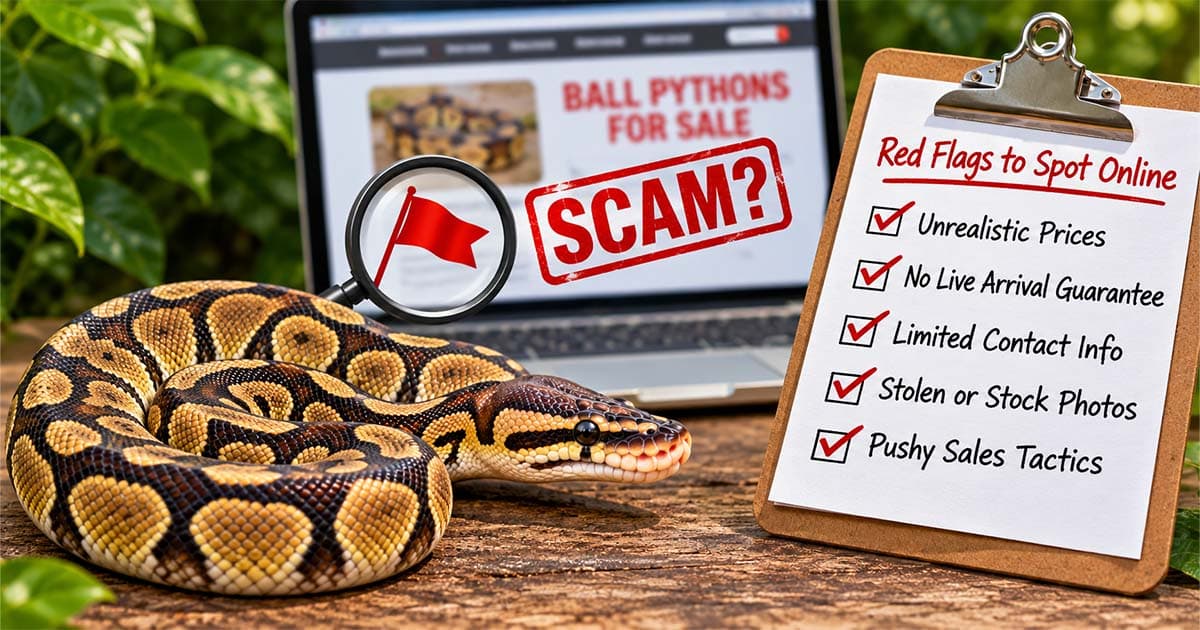
Ball Python Buying Scams: Red Flags to Spot Online
Buying a ball python morph online is normal in this hobby and avoiding ball python buying scams is important. Most sellers are legitimate, ship healthy animals, and stand behind them. A small number are not, and money moves fast once a listing looks good.
Avoiding scams is one part of buying ball python morphs online safely. Knowing the warning signs protects your wallet and your purchase. The patterns below repeat across forums, classifieds, and social groups where buyers share their losses.
Why Online Ball Python Sales Attract Scammers
Demand for high end morphs is real, and photos travel faster than animals do. A single good picture of a rare morph can be copied and reposted as a fake listing within minutes. Hobby threads show the same story again and again: a buyer pays, then the seller goes quiet.
Impersonation runs in both directions. Breeders report scammers reaching out through the phone number attached to their profiles, asking about a specific snake. Others show up pretending to be that breeder. Both moves rely on a buyer who does not check.
Red Flag: A Price Far Below the Going Rate
A price dramatically below the typical market rate for a morph is one of the clearest warning signs. That gap is the bait. It makes a buyer rush before someone else grabs the deal.
Learn the rough range for the morph before you shop. If one listing undercuts every other seller by a wide margin, ask why. A real breeder can explain the price with age, genetics, or a holdback. A scammer only has excuses.
Red Flag: No Live Arrival Guarantee
Shipping a live animal is a risk, and honest sellers spell out who carries it. Ask where the guarantee is written and what it covers. Ask what happens if the snake arrives cold, limp, or not at all.
A seller who dodges that question, or answers only in a private message, is telling you something. XYZReptiles offers a live arrival guarantee on all animals and ships overnight on Tuesdays and Wednesdays. That is the level of detail you should expect from any seller before you pay.
Red Flag: Vague or Evasive Answers About the Animal
Real breeders talk specifics. They know the hatch date, the feeding schedule, the last meal, and the pairing behind the morph. Good seller guides list vague or evasive answers about the animal as a core red flag, and for good reason.
Ask about feeding, shedding, and temperament. Ask for the genetics behind the pairing. Ask what the snake is eating and how often. Short, fuzzy answers on basic care questions usually mean the person has never kept the animal.
Red Flag: Pressure to Buy Right Now
Urgency scripts are everywhere: three other buyers are interested, the price only holds today, payment is needed within the hour. These deadlines exist to stop you from checking the seller’s history.
A real breeder will hold an animal for a serious buyer. Nobody loses a sale because you asked some questions. If the deal collapses when you slow down, it was never a real deal.
Red Flag: Photos That Do Not Belong to the Seller
Scammers lift photos from established breeders and high end collections. Hobby discussions describe a large number of Facebook scammers using pictures taken from well known ball python breeders. The photo sells the animal before anyone asks a question.
Reverse image search the listing pictures. Then ask for a dated photo or a short video of the snake in the seller’s own setup. Someone who actually owns the animal can produce that in minutes.
Red Flag: No Verifiable Identity or History
Look for a business name, a track record, and reviews in more than one place. Buyers ask each other which websites they trust for a reason. Reputation is the hobby’s main safety net.
Be careful with accounts created last week and profiles with no posting history. Watch for impersonation too. Confirm details through the seller’s official channel, not through a number or link sent in a direct message.
Red Flag: Payment Requests That Leave the Platform
One common pattern involves a message that looks like it comes from the seller, asking for payment off the marketplace. Scammers text or email pretending to be the seller, take the money, and disappear.
Keep the deal inside the platform where you found it. Use a payment method that creates a record. If a seller insists on moving the conversation to text and paying fast, treat that as a warning, not a convenience.
Red Flag: The Seller Never Asks You Anything
A real breeder wants to know where the snake is going. Expect questions about your enclosure, your experience level, and your plans for the animal. That curiosity is a sign the person cares about the outcome.
A scammer only needs a payment. If there are no questions about your setup and no care advice, the animal may not exist at all.
Red Flag: Listings That Live Only in Free Classifieds
Craigslist and Facebook groups carry a lot of scammers, according to hobby discussion. Not every free listing is bad, and plenty of keepers have found good animals that way. The caution level just needs to be higher.
Ask for extra proof, a phone call, and a current video. A legitimate local seller will usually be happy to talk. Resistance to basic verification tells you to move on.
Red Flag: No Clear Shipping Plan
Ask how the animal ships, on what days, and with what packaging. Ask who is responsible if the shipment is delayed. Real sellers answer these questions without hesitation because shipping is routine for them.
A seller who cannot describe the process has probably never shipped a reptile. That is a serious problem when the animal is supposed to arrive alive.
Avoid Ball Python Buying Scams With A Quick Checklist Before You Pay
- Reverse image search every listing photo.
- Confirm the live arrival guarantee in writing.
- Request a dated photo or video of the snake in the seller’s setup.
- Ask for the morph genetics and the feeding history.
- Check reviews on more than one platform.
- Verify the seller’s identity through their official contact details.
- Use a payment method that leaves a record.
- Walk away from any deal that rushes you.
If You Think You Have Been Scammed
Act quickly. Save every message, screenshot, and payment receipt. Contact the payment provider and the platform where the listing appeared.
Report the account to group admins. Buyers in these communities compare notes constantly, and a repeat scammer gets shut down faster when several people speak up. Also contact the breeder whose photos or name were used, since they are usually the next target.
One detail from those threads is worth remembering. Buyers who got scammed often describe buying a full setup for an animal that never arrived. The financial hit goes beyond the purchase price.
What a Better Buying Experience Looks Like
A trustworthy transaction feels slow and specific. The seller answers questions, shares details, and explains shipping without pressure. Photos match the animal, the morph genetics make sense, and the guarantee is easy to find.
XYZReptiles focuses on captive-bred ball pythons for sale and ships overnight across the lower 48 states with a live arrival guarantee. Buying from a seller who publishes that information is the simplest way to avoid the scams described above.
Frequently Asked Questions
How can I tell if an online ball python seller is legitimate?
Check the business name, reviews on more than one platform, and a written live arrival guarantee. A real seller will answer specific questions about feeding history and genetics. Reverse image search the listing photos. If the account is new, has no history, or avoids a direct conversation, buy elsewhere. Legitimate sellers expect to be checked.
Should I ask for more photos before paying?
Ask for a dated photo or a short video first. A seller who owns the animal can show it in their own setup within minutes. If they refuse or want payment to prove interest, treat that as a warning. Move on to a seller who answers questions before asking for money.
Why do scammers use stolen ball python photos?
High end morph photos are easy to copy and make a fake listing look credible. Hobby discussions describe scammers using pictures taken from established breeders. The photo sells the idea, then the payment disappears. A quick reverse image search often exposes a listing using the same picture as several others.
What should I do if a seller pressures me to pay fast?
Slow down. Urgency is a tool that keeps you from verifying the seller, the animal, and the guarantee. Ask for current photos, written guarantee details, and payment information in writing. A genuine seller will still be there tomorrow. If the deal vanishes when you ask questions, you avoided a loss.
Is a seller’s own website safer than a marketplace listing?
A seller’s own website with a business name, published policies, and a live arrival guarantee gives you something concrete to check. Marketplace listings can work out fine, but reviews and a site give you a paper trail. Confirm details through the seller’s official contact, not a number sent in a message.